You sold a building in France through an agent, and you discover years later that the price was far below its value. What remedies remain open, and within what time limits? A ruling of the Paris Court of Appeal of 12 January 2018 answers these questions in the case of a café-hotel, and states a rule every owner should know: the seller is deemed to know the value of the property and its floor area. The case also shows how statutory eviction compensation is calculated and how the value of a hotel business is approached.
The facts
The X. family gave a consultancy company a mandate to sell their Paris café-hotel. The manager of that company found a buyer: her own brother, who bought through an SCI (société civile immobilière, a French property-holding company) of which he was the manager. The sale was signed in 2008 at a price of €398,000.
In 2009, the SCI served notice of non-renewal on the operating tenant, a limited company (SARL) running the café-hotel. In the absence of an amicable agreement on the eviction compensation, an expert was appointed in 2010; he filed his report in 2012.
Eviction compensation
A landlord who refuses to renew a French commercial lease (bail commercial) must, save for a serious and legitimate reason, pay the tenant an eviction compensation (indemnité d’éviction) equal to the loss caused by the non-renewal (article L. 145-14 of the French Commercial Code). It includes in particular the market value of the business (fonds de commerce, the going concern: goodwill, lease rights, fixtures, clientele), determined according to the customs of the trade, increased where appropriate by the normal costs of removal and reinstallation, and by the transfer costs and duties payable for a business of the same value, unless the landlord proves that the loss is smaller. The Charte de l’expertise en évaluation immobilière (French property valuation charter), 6th edition, Title III, §1.19, adopts this definition.
Approaching the value of a hotel business
The valuation of a hotel rests on the operator’s accounts and on trade ratios (Charter, Title III, §2.4 and §2.9). A common rule of thumb, recalled in the book “Expertise immobilière” published by Eyrolles, puts the value of a profitable hotel business at between 1 and 2.5 times turnover including VAT, up to 3 for an exceptional establishment. The multiple depends on the durability of the business: location, clientele, team, condition of the building, compliance with standards.
The published accounts of the operating SARL showed turnover excluding VAT of €578,900.
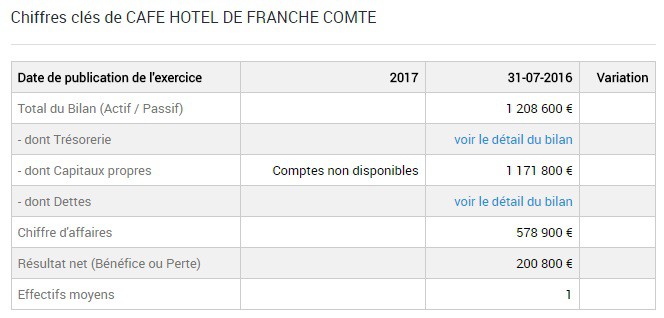
Simplified estimate, by way of illustration:
- With an average VAT rate of 10 % on accommodation and catering, turnover including VAT comes to about €636,800, rounded to €650,000 to allow for alcoholic drinks and ancillary services taxed at a higher rate.
- The establishment has fair prospects without being exceptional: inner Paris, but a working-class street, a budget clientele, few staff, an ageing building. An intermediate multiple of 2 gives a business value of €1,300,000.
In a real valuation, this figure would be tested against sales of comparable businesses and against other approaches (gross operating profit, cash flows). If the business is worth €1,300,000 and generates about €200,000 a year, the buyer recovers the purchase price in about seven years, which matches the customs of the sector.
Adding ancillary compensation (reinvestment costs, trading disruption) of around 10 %, the eviction compensation could reach €1,430,000, more than three times the price at which the walls were sold. That gap is what alerted the sellers.
Were the walls sold below their value?
A quick income calculation gives an order of magnitude. A hotel with turnover of €578,900 excluding VAT can bear a rent of around 15 %, or €86,835 per year. Capitalised at 7 %, that rent leads to a market value for the walls of about €1,240,500. A full valuation would rebuild the turnover using the hotel method and justify the capitalisation rate with market references (Charter, Title III, chapter 8). But the gap with €398,000 is such that it leaves little doubt.
Alerted by the tenant, who wished to stay in the premises and was seeking to have the sale annulled, the X. family changed their minds on reading the 2012 report and brought an action.
The remedies and their time limits
Rescission for lesion
“If the seller has been prejudiced by more than seven twelfths in the price of a building, the seller has the right to seek rescission of the sale” (article 1674 of the French Civil Code; this is lésion, gross undervalue). On a value of €1,240,500, lesion is established as soon as the price is below 5/12 of that value, that is €516,875. The price of €398,000 is well below.
The action must, however, be brought within two years of the day of the sale (article 1676). In 2012, that period had long expired.
Derisory price
The sellers then relied on the derisory price (vileté du prix), a ground for annulling the sale (article 1658 of the Civil Code for contracts before 1 October 2016; article 1169 for later contracts). The time limit here is five years (article 2224), but it too had run out: the sale dated from 2008.
The agent as buyer
The sellers denounced the link between the agent and the buyer, sister and brother. Article 1596 of the Civil Code prohibits agents (mandataires) from buying, themselves or through an intermediary, the property they are instructed to sell. The Court adopts a strict reading: it was not the agent who bought, but her brother, through an SCI. The family link raises a question of professional ethics, not a ground for annulment.
Fraud
That leaves fraud (dol), that is, obtaining consent through manoeuvres or lies (article 1137 of the Civil Code, formerly article 1116 for contracts before 2016). The sellers put forward two elements: the floor area stated in the mandate was wrong (201.54 m² instead of 586.81 m²), and the price, derisory, had been set by the agent.
The Court replies that “the seller is deemed to know both the market value of the property and its floor area”. The X. family “could not have been unaware that they were putting up for sale a 42-room hotel on several floors”. The energy performance certificate (DPE), drawn up before the property was put on the market, in fact stated the floor area of the property.
What the ruling teaches
The sellers’ age or distance were not accepted as excuses. Faced with large sums, the owner is expected to act as a diligent seller: seek several opinions, and preferably commission a valuation independent of the agent instructed to sell. The Charter (Title I, §4.1.3) defines a conflict of interest as any situation in which a personal, professional or financial interest of the expert is liable to influence, or to appear to influence, their judgement; a report drawn up by a third party with no link to the transaction meets that requirement.
A prior valuation report, for a building used as a hotel, would have measured the gap between the proposed price and market value, and allowed the sellers to act within the time limits, or not to sell.
Further reading
The Property loss of value page describes the assignment of quantifying a sale concluded below value. Two articles complement this one: can a sale be cancelled because you were taken in and how to value a hotel: seven methods and a worked example.
What next
Has your property lost value because of a third party?
Neighbouring construction, hidden defect, wrong floor area, overpayment at purchase: the loss of value and the loss of enjoyment quantified with the method accepted by French courts.
Free quote, by email or by phone. No commitment before the quote is accepted. Fees are never linked to the value of the property (Charte de l’expertise, Title I, §2.1).